
Jump to main content
Logo
A bearded man wearing a hat looks at the camera as he reads on his IU notebook, with the Cologne bridge visible in the background.
Blog & News
A bearded man wearing a hat looks at the camera as he reads on his IU notebook, with the Cologne bridge visible in the background.

Business Administration in Germany: The 2026 Guide for International Students

Article • reading time: 20 min. | 01. June 2026, written by Gianna Barabasch

Learn more about IU

Studying Business Administration in Germany: At a Glance

  • Studying business administration in Germany can kickstart your business career in a thriving modern economy.

  • Post-graduate life in Germany offers many benefits, including the potential to earn a high salary and enjoy an exciting culture.

  • A Bachelor's Business Administration degree provides a strong entry point to the corporate world in Germany.

  • Gaining a Master's in Business Administration creates a bridge to higher-level management careers and impressive salaries in Germany.

  • Germany is home to many of the world's leading business schools.

  • Studying business administration in Germany opens a wide variety of career pathways, including marketing, HR management, supply chain, and operational roles.

If you're considering studying business administration abroad and haven’t picked your ideal destination yet, Germany is an excellent choice. Over 405,000 international students opted to study here in 2024/25, and for good reason. German universities are respected worldwide, and private institutions have very accessible admission requirements. 


On this page, we’ve gathered all the information you’ll need to know about studying business administration in Germany. To help you make the best decision, this guide will cover:

  • Programme choices

  • Tuition fees

  • Application deadlines

  • Admission requirements

  • Career opportunities

Why study business administration in Germany?

A woman wearing a dark jacket and jeans is sitting on a bicycle in a Cologne city street, looking at the camera and touching her hair.

There are multiple advantages for international students to consider when choosing to study in Germany, including the possibility to apply for an 18-month post-study visa for job-seeking and the high standards of education on offer. The reasons are not purely academic, though, as there are plenty of lifestyle benefits too.


Germany has a high standard of living, yet its cost of living is lower than in other European nations like the UK or France. It has some of the highest average salaries in Europe, and is also known for its efficient infrastructure. There is plenty of public transport, a rail network that connects to neighbouring countries, and a comparatively low crime rate, making it an incredibly comfortable place to live.


Germany also offers a thriving culture for students. It's filled with entertainment hotspots, museums, restaurants, and other attractions that make everyday life more entertaining. A significant number of the population speaks English, too, so it’s possible to get around even with limited knowledge of the German language. 

Types of Business Administration degrees in Germany

There are two main types and levels of Business Administration degree in Germany, including:

  • Bachelor's degree

  • Master’s degree (including MBA programmes)

Let's take a closer look at each one:

Bachelor’s degree

A Bachelor's degree in Business Administration is the entry point for students who want to take their first step into the wider business world. It typically lasts for 3 years (6 semesters / 36 months), and covers fundamental business topics like:

  • Business mathematics

  • Managerial economics

  • Agile project management

  • Sustainability

  • Statistics

  • Financial accounting

  • Leadership

  • Principles of management

  • Corporate social responsibility


Choosing this programme will immerse you in everything from applied sciences and practical learning to internships and real-world career prep. Studying a Bachelor's degree in Germany is a highly rewarding experience that allows you to unlock your business potential.


Kickstart your career in Germany with IU's Bachelor (BA) in Business Administration today. Study on campus in Cologne or Berlin and build a strong foundation in global business through practical learning and real-world experience. With English-taught classes, hands-on projects, and strong career prospects in Germany, this programme prepares you to thrive in an international business environment.

Bachelor's specialisations

Alongside the compulsory modules, Germany’s bachelor-level degrees often provide the opportunity to pick specialist subjects. These programmes can help you gain industry-relevant knowledge and hands-on experience in a specific field, enabling you to pursue a particular interest or career path.


To supplement the standard business administration degree, you can select your focus from a variety of subjects. For example, at IU International University of Applied Sciences, our specialisations include:

Please note: To study the B.A. Business Administration at IU, you MUST choose a specialisation.

Master’s degree (including MBA programmes)

A Master’s degree in Business Administration (M.Sc. or M.A.) is a postgraduate qualification designed to deepen students’ academic knowledge and develop advanced analytical and management skills. In Germany, these programmes are offered by many german universities and typically build on a relevant undergraduate degree in business or a related field.


In addition to traditional Master’s programmes, many German universities also offer MBA (Master of Business Administration) degrees. While both are Master’s-level qualifications, they differ in focus: Master’s programmes are more academic and theoretical, whereas MBA programmes are more practice- and management-oriented, often designed for professionals with work experience.


At IU, MBA programmes are designed to strengthen leadership and management capabilities through practical, career-oriented learning approaches, including case studies and projects, all while preparing students for international business environments.


Most Master’s programmes include similar core modules, although content may vary depending on the university. Typical subject areas include:

  • Managerial economics

  • Marketing strategy

  • Sustainability

  • Principles of management

  • Corporate responsibility

  • Strategic management

Many programmes also include a compulsory internship or practical project to strengthen real-world experience.


MBA programmes in Germany typically last 12–24 months, depending on the study format. Admission requirements vary, but applicants are usually expected to hold a recognised undergraduate degree and, in the case of MBA programmes, relevant professional experience.


Overall, a Master’s degree can enhance career opportunities by providing advanced knowledge and skills for higher-level roles in business and management.

MBA specialisations

Most German institutions typically offer both a standard MBA and more specialist ones that hone in on niche topics. For example, at IU, we offer the following specialisations:

Business administration studies vs business management vs international business

If you’ve spent any time researching business degrees, we imagine you’ve encountered two others alongside business administration: business management and international business. So, what’s the difference?


All three courses overlap, and each provides you with an excellent career foundation. However, there are distinctions. In short:

Business administration 

These degrees focus on the practicalities of running a business, including HR processes and finance. Business administration is focused primarily on ensuring day-to-day operations run smoothly, identifying areas for improvement, and implementing changes to increase efficiency.

Business management

These courses revolve more around leadership strategies and team organisation. In contrast to business administration, business management courses are more about fostering and driving growth. Management and administration work hand in hand, so there is some overlap in study areas.

International business

These courses are centered around global trade markets and the nature of business across different backgrounds. International business could be considered a sister subject to business management, but with an expanded scope at the global level. International business courses cover the complexities of navigating different economic and cultural landscapes to foster efficient working relationships.

Best universities and business schools in Germany for Business Administration

Leading institutions

Germany is home to a number of top universities. All have strong reputations and are worth considering as study locations. Some of the more significant names are:

  • The Mannheim Business School: established in 2005, and regarded as one of the world's leading business schools. The Mannheim Business offers four international MBA programs and is notable for being located at the Mannheim Palace, one of the largest baroque castles in Europe.

  • The Frankfurt School of Finance & Management: located in the city of Frankfurt, this private university attracts a wide variety of international students, especially those interested in auditing careers. Manager Magazin ranked it as Germany's best higher education institution for auditors in March 2024.

  • WHU - Otto Beisheim School of Management: based in the town of Vallendar in the Rhineland-Palatinate state, this private university was founded in 1984 and has several notable alumni from the German business world. In 2024, it achieved 16th place in the Financial Times' European Business School Rankings.

  • IU International University of Applied Sciences: founded in 1998, IU is the largest private and state-accredited university in Germany. It is recognised as a leading choice for international students, as well as for practical, career-oriented study programmes. Courses are taught fully in English on campus in Cologne or Berlin.

What to look for in a business school

There are a few things to consider when choosing where to study business in Germany. From an academic and career progression standpoint, we recommend checking:

  • Accreditations: explore the accreditations. Major ones include the AACSB, the USDLA, and the BGA. They are a good indicator of the school’s reputation and standing in the wider education community.

  • Industry links: what connections does the school have with the wider business community? Do they offer networking events with the local business sector, the international business sector, or both?

  • Practical projects: does the school incorporate internships and other hands-on study opportunities to help develop your personal skills? A successful career doesn't start with purely theoretical study.

  • Career pathways: will the school help you achieve your academic goals with career-oriented education? Look for degrees that come with personalised career support and strong graduate employability outcomes.

Alongside this, there are also day-to-day lifestyle factors to consider. You may have found the perfect school academically, but is it located somewhere you could see yourself living for three or more years? Are there plenty of accessible transport links? You're not just studying abroad, you're becoming immersed in the local culture. In the lively student city of Cologne or Berlin, you’ll have a full and rich international student experience in Germany.  

Admission requirements for Business Administration in Germany

Although the application process for a Bachelor's, Master's or MBA can seem complex, we will try to make it straightforward:

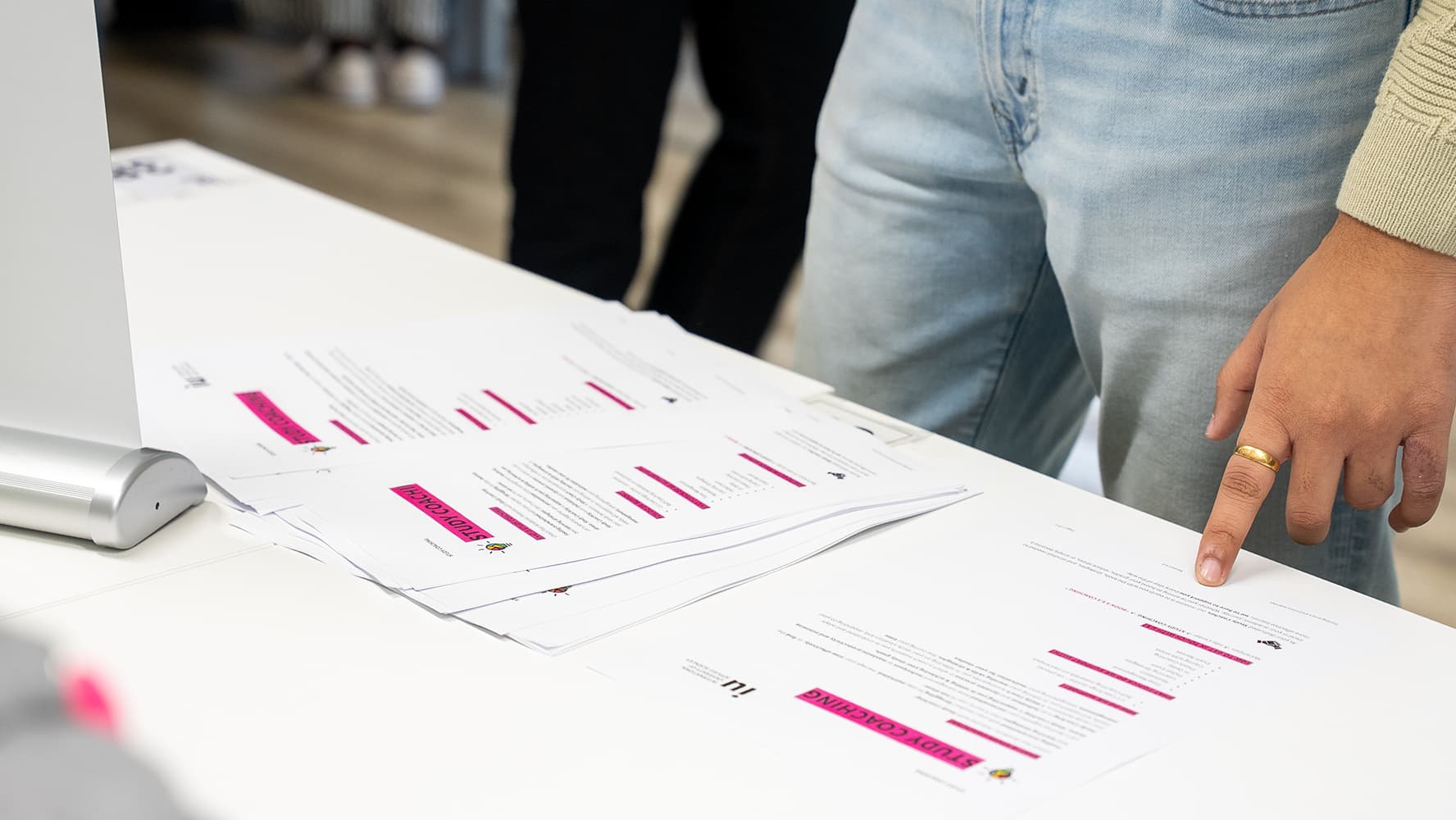
A hand wearing a gold ring is pointing at an IU document lying on a white table, surrounded by other papers.
Your future in Germany awaits!

Want to study and work in Germany? Get your free IU guide via email.

Tuition fees and living expenses for business administration in Germany

Pursuing your business administration studies in Germany is an incredible experience, but what about the cost? The good news is that it might be cheaper than you expect! Germany is noted for investing heavily in its education system, and tuition fees are lower than those for comparable courses offered by the US, Canada, the UK, or Australia.

Tuition fees at public universities

Public universities are often the cheapest option. The majority of public universities in Germany charge either low tuition fees or no fees at all! There is, however, one exception: the south German state of Baden-Württemberg.


This region introduced tuition fees for non-EU and non-EEA international students during the winter semester of 2017. There has been considerable debate over it, but at the time of writing, the fees have not been lifted.


Despite this, however, the region still attracts an enormous number of international students. The state is home to several prestigious institutions, such as the Karlsruhe Institute of Technology, and its fees are comparatively lower than those in neighboring countries. The typical Baden-Württemberg tuition fee is around €1,500 per semester.

Tuition fees at private institutions

Unlike their public contemporaries, private universities do charge tuition fees. At IU you can expect to pay:

  • Bachelor's: From €3,485 per semester, and up to €20,910 in total.

  • MBA (90 ECTS): From €5,016 per semester, and around €15,050 total.

  • And a one-time campus registration fee of €1,500.

While you might question paying for a degree when Germany offers free education, it’s worth remembering the advantages. Private universities tend to have smaller class sizes, so you’re getting a higher rate of tuition than students at a public university. 


Furthermore, there are plenty of networking opportunities. Rather than being just another graduate at a job fair, you’ll have the chance to connect directly with world-class professionals. Private institutions also tend to provide additional support. For example, IU offers focused career services, study coaching and visa assistance, and 89% of its students and alumni confirm that their degree was a worthwhile investment.

Three students are smiling and playing table football in a brightly lit room at the IU Cologne campus.

Living expenses for international students

When budgeting, bear in mind that you are not just paying for your study programme. You'll also have to fund rent, health insurance, transport, and various day-to-day expenses, such as food and entertainment.


At a glance, we recommend setting a target of €990- €1,500/month to cover the cost of studying in Germany.


It's also worth remembering that those fees and living expenses don't vanish into a black hole. Your tuition payments support various career services and help keep class sizes manageable. There are also support systems for international students, including visa application assistance, study coaches, and opportunities to learn German.

Career opportunities after Business Administration in Germany

Completing a Business Administration degree in Germany demonstrates commitment to a task and a level of responsibility that’ll help you stand out from other job candidates.


Germany attracts global business institutions and has a widely respected homegrown start-up scene. In 2025, it attracted €8.4 billion in venture capitalist investment and saw a 29% increase in new start-ups compared to the previous year. It’ll open numerous career opportunities, and not just in Germany itself. 


The country's position at the heart of the European mainland gives it a tremendous strategic advantage. It provides easy access to neighbouring countries and offers students who choose to study here an enviable number of opportunities to enter the wider business world. 


As you’ll see, Germany also has some of the highest average salaries in Europe, with potential career prospects including:

Supply Chain Management

Interested in pursuing a career in supply chain management? A business administration degree provides a strong foundation. Students will learn in depth about the challenges of structured organisational planning and develop skills that are ideally suited to this career. You could also specialise in this route by focusing on logistics. Supply chain managers are in high demand in Germany and earn wages of around €66,000 per year.

Marketing Roles

Germany’s economy relies heavily on international trade and continues to attract international investment. Its GDP is ranked third in the world, and it has thriving automotive, electrical, and mechanical engineering sectors that constantly demand marketing professionals. Marketing is a wide and varied career, and a business administration degree works as a sturdy launch pad for a career in it. It’ll foster the skills you need to thrive. Graduates who pursue a career as a marketing manager can earn around €40,000 - €80,000 per year

Business Analyst Roles

A business administration degree teaches students how to assess working structures, identify weaknesses, and help foster growth. Business analysts in Germany have a median salary of €60,000 and enjoy a highly rewarding career.

HR Management

The degree can also help you enter the field of human resources. It develops skills in areas like managing employee relations, which will prove useful and should impress prospective employers. There is high demand for HR professionals in sectors such as pharmaceuticals, technology, engineering, and manufacturing, offering a wide scope for development across Germany. Salaries as a Human Resource Specialist can range from €42,000 to €63,000 depending on the city.

Operations And Planning

There is a demand for operations specialists in Germany, too. A business administration degree develops skills ideally suited to these roles, with a focus on efficiently running a business proving invaluable. Operations experts in Germany typically earn around €65,000 per year.

Post-study work options and job search pathway

Studying abroad can be extremely fulfilling and offers an unforgettable life experience. But what about after you graduate? We understand that navigating life in a foreign country can be intimidating, but with our help, you'll thrive.


Once you've graduated, you'll be able to apply for an 18-month residence permit, giving you the chance to remain in the country for a further year and a half. During that time, you can explore the job market and, if you so wish, pursue permanent citizenship. 


To start finding jobs in Germany and begin your career, you can follow routes like:students at IU can get dedicated support for building their careers. Our in-house careers service team can help you write an eye-catching CV, provide access to career workshops, and find internship roles. IU graduates find a suitable job within 2.6 months on average. One of the clearest signs that our programmes are built around what employers actually need.

Want to know more?

Explore our Bachelor and Master degrees in Business Administration and join us in our next intake at the IU Cologne Campus.

B.A. Business AdministrationMBA Master of Business Administration

Choosing the best business course in Germany

A man wearing glasses and a brown shirt is touching his chin while looking down.

Pick your specialisation based on career goals

Choosing a business course can feel like a daunting task. After all, this is a decision that can greatly alter the direction of your life. That's why we've decided to make it a little easier.


All the courses at IU International University of Applied Sciences are designed with your futures in mind. Let's consider each specialisation and where it's likely to lead you.

  • Focus on international business and international management, and you'll open the door to working with multinational teams. You'll have a greater chance of working in an import/export business, in a role that could take you all over the world.

  • A human resources specialisation, on the other hand, is more likely to result in people-focused operations management.

  • Interested in operations and procurement? Consider a course specialising in supply chain management and logistics.

  • And lastly, there's going to be the budding entrepreneurs among you. While an entrepreneurship specialisation sounds like it'll be solely for building your own business from scratch, employers value graduates with these skills. We've seen graduates receive job offers for venture-building roles. There is a world of opportunity out there.

Public universities vs private business schools: who should choose what?

Not sure whether to go public or private? Germany is home to a multitude of public institutions, and there are plenty to choose from. However, there is fierce competition for space in Business Administration courses, especially since public institutes rarely charge fees.


Students from abroad may be tempted by the offer of free education, but a university of applied sciences might be a better choice. Known as Fachhochschule, they focus heavily on practical orientation. In other words, this means there are higher rates of internships and case studies.


Alongside considering tuition fees, choosing between public universities and private business schools is a matter of personal preference.


If you're fluent in the German language, public universities are a good choice. Private universities, meanwhile, allow you to study fully in English and offer greater opportunities for career development, making them the best for international students.


This gives you the opportunity to practice the language and is also an effective form of "international orientation." English is the international business language, and studying abroad earns considerable respect.


For the business-minded student, private universities also offer:

  • A greater emphasis on practical business administration

  • The opportunity to liaise directly with business figures

  • A robust support model

  • Experience with applied sciences

It might seem daunting, but the chance to earn a respected degree at an internationally recognised institution is unmissable. As the tuition is in English, there is less of a language barrier, too.

Why IU for international students

With so many options for international study available, why choose IU? Simply put, we're the best at preparing you for a long and successful career. Plus, we offer comprehensive support while you're here. Moving abroad for your studies can be daunting, but we'll help make the transition as smooth as possible and ensure you thrive.


As part of our student body, you'll experience practical learning and career-oriented teaching from professors with extensive industry experience. You're not just getting an academic qualification, but being prepped for a future in the world of business. We've also embraced modern tools, including our AI learning assistant Syntea and our digital learning platfrom MyCampus.

Four students sit on dark grey tiered seating in front of a large screen displaying the Cologne skyline and the text 'WELCOME TO THE IU CAMPUS IN COLOGNE'.

Other benefits of studying business administration at IU include:

  • Internationally Recognised Qualifications: We’ve numerous international awards and accreditations.

  • Visa Support: We can guide you through the visa application system and make the process easier.

  • English-Taught Courses: Our courses are taught entirely in English, so you don’t have to be fluent in German to study here.

  • International Environment: Cologne is a welcoming and vibrant city with a huge international community. 

Ready to start your business career by studying abroad in Germany? Master your potential with the Bachelor's (BA) of Business Administration through IU, or explore our other degree options.

FAQ

You might also be interested in these articles

Young woman with curly hair, dimples, and hoop earrings smiles while riding a bicycle on a brick path in front of colorful buildings and trees.

Best countries to study abroad

If you're looking to spread your wings and attend a foreign university, you have plenty of options. But what are the best countries to study abroad? Our guide reveals the top eight countries for international students, complete with information on visas, culture, cost of living, university rankings, and career prospects.

Read more
A group of international students posing for a picture at an IU party to depict international student life in Germany.

What is like for International students in Germany?

In this article, we cover some things you should know about being an international student in Germany, such as your right to work, costs, and what it's like to be a student here.

Read more

Award-winning education at IU