

Education for democracy, also known as civic education, involves teaching about democracy and democratic values.
In recognised democracies like Germany, civic education should be commonplace and comprehensive. But this is not always the case. To uncover the current state of education for democracy in Germany, we at IU International University of Applied Sciences conducted a survey of 1,213 people across a diverse range of ages, genders, occupations, education levels, and regions.
Our report reveals the attitudes, needs, reflections, and desires of the German public concerning civic education. This includes satisfaction levels, political participation, democratic benefits and challenges, and who is responsible for education for democracy.
Download our full report today to read our findings.
About the Study
Respondents were between the ages of 16 and 65. Most (51.1%) lived in North Rhine-Westphalia, Bavaria, and Baden-Württemberg, with the remaining 48.9% residing in 13 other states (including Berlin and Lower Saxony).
An even spread of respondents said their highest level of completed education was secondary school (28.9%), a basic secondary school diploma (30.3%), or an advanced technical college or university qualification (35.2%). The remaining respondents were either still in school or had no school-leaving certificate.
Highlights from Our Report
Our survey uncovers the current state of civic education and the perception of democracy in Germany. Education providers can use our findings to improve their teaching and regulate their stance on democracy, promoting active democratic citizenship and providing educational and training tools accordingly.
The full report details how people perceive democracy and where the responsibility for civic education lies, alongside AI and social media's roles in forming strengthened democratic processes and shaping citizenship education and political participation.
Are People Satisfied with Democracy in Germany?
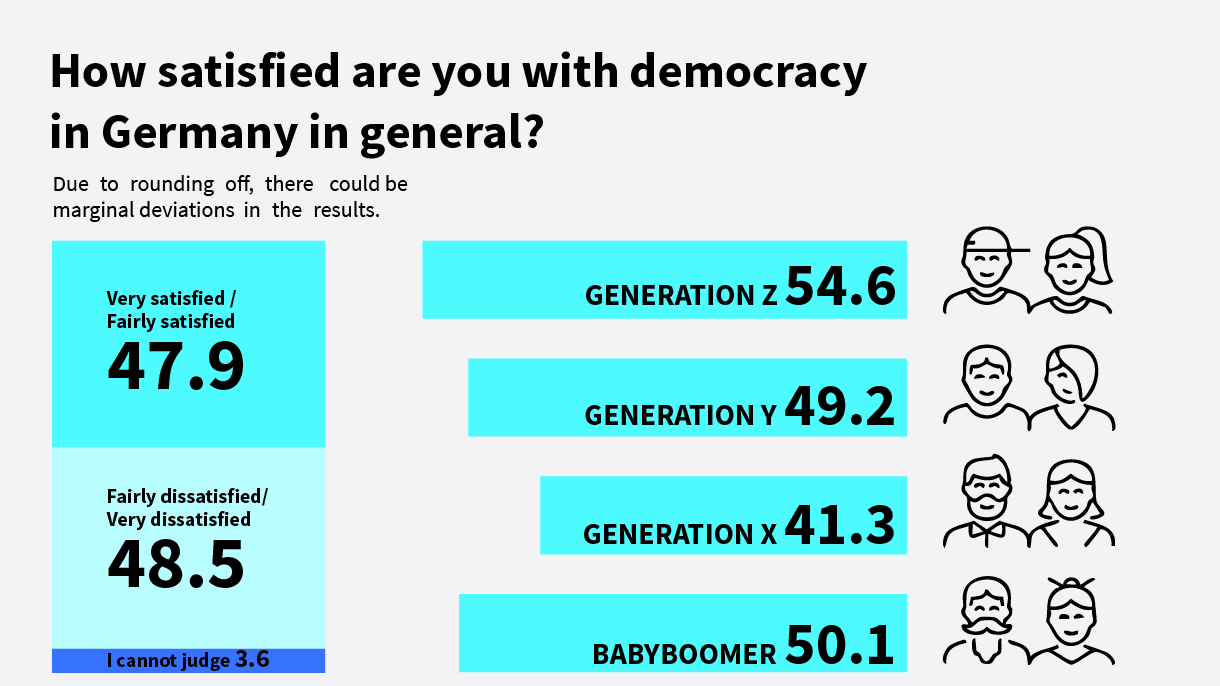
Yes and no - it's almost a 50-50 split. Our survey found that 47.9% of respondents were satisfied with democracy, while a slightly larger percentage (48.5%) were dissatisfied with democracy in Germany.
These figures vary slightly between age groups. Curiously, it is Generation Z who are most satisfied with democracy, while Generation X are the least satisfied. Our full report details the exact percentage of respondents in each age group who expressed satisfaction with democracy.
Should We Preserve Democratic Values?
Preserving democracy is overwhelmingly important for Germans - 92.5% said so.
Democratic values involve the concepts of freedom and equality. Under a democracy, people are free to express their opinions, beliefs, and cultures. This typically equates to ethnocultural and linguistic diversity and sustainable development with fair and representative discourse.
What Political Participation Do People Take Advantage Of?
Independent of views, there are various channels of political participation available in a democracy. The most common channel is voting, which 75.1% of respondents said they do regularly.
Other methods of political participation include keeping informed about current affairs, discussing politics with others, signing petitions, engaging in discussions via social media, participating in demonstrations, and contacting political representatives.
Download our full report to see the percentage of the population that participates in each of these political actions.
Politics Deconstructed: What's Good and Bad About a Democracy?
Our study highlights the reputation of democracy among the German population, underpinning the benefits and challenges of active democratic citizenship.
Benefits of a Democracy
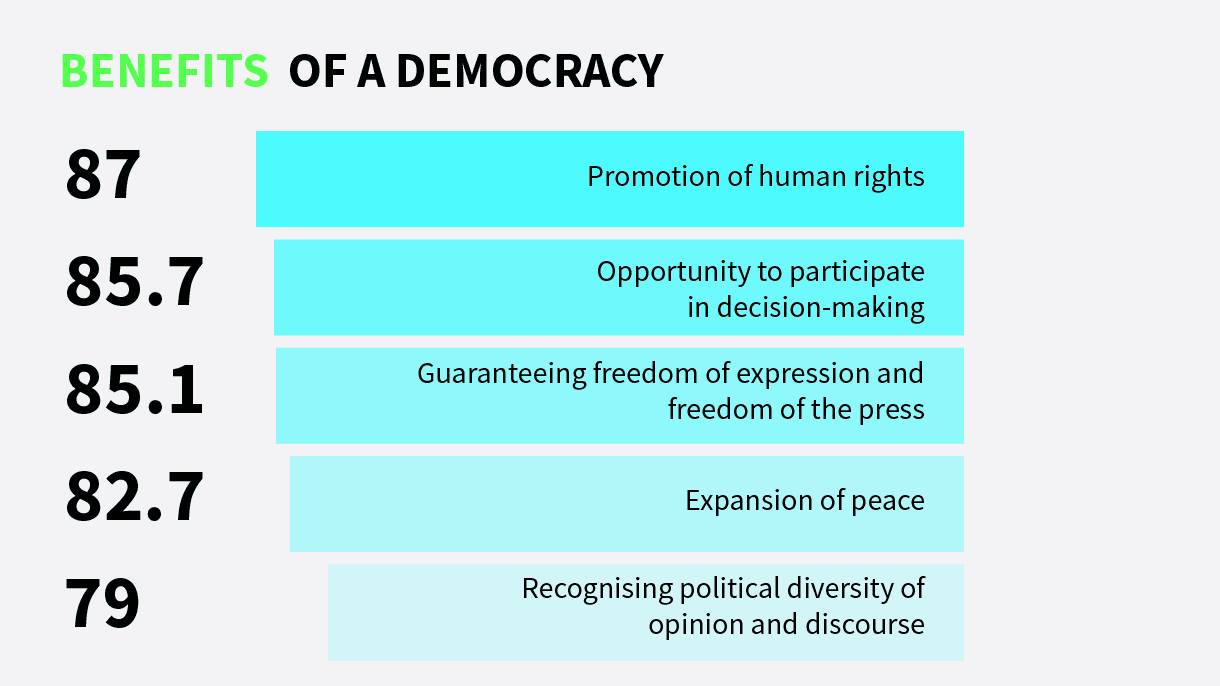
What are the advantages of democracy? Our report details five clear benefits of a democratic system, as relayed by our respondents:
In fifth place, 79% of people said that recognising political diversity of opinion and discourse was an advantage of democracy.
Fourth on the list, 82.7% of respondents said expansion of peace was either a "major advantage" or "somewhat of an advantage".
The third most significant benefit of democracy, with 85.1% of respondents agreeing, is guaranteeing freedom of expression and the press.

Challenges of a Democracy
Conversely, our respondents also rated the challenges a democracy faces. The top five included:
A lack of connection with citizens (76.3% of people expressed this was either a "major challenge" or "somewhat of a challenge").
Digital disinformation and fake news, with 77.6%.
Increasing social inequality was in third place, with 79% of respondents highlighting it as a challenge of democracy.
Most people in Germany see the decline in trust in politics as a challenge facing democracy. Therefore, we need to find ways to make politics interesting and relevant to people’s everyday lives. This can be achieved by providing more opportunities for participation, more transparent communication, and by involving the population more.

Prof. Dr Alexandra Wuttig
Chancellor of IU International University of Applied Sciences and Professor of Innovation and Entrepreneurship
Who is Responsible for Civic Education?
Family, media, the government, or education providers - who should teach democracy education?
Different age groups think differently, but the most common answer (with 59%) is that the German education system is responsible for teaching and bolstering democratic values.
Indeed, more than four out of five people in Germany say that education can help them make more informed voting decisions. This political education involves teaching cultural and textual literacy on society's humanistic and civic aspects, spanning both cultural and creative sectors.
Schools and universities must engage with civic education because it helps people develop critical thinking skills and responsible historical consciousness. In turn, this leads to clearer voting decisions and a broader perspective of the active political systems in society.
However, education must be done correctly. Two-thirds of our respondents warned that education is not a guarantee of a functioning democracy.
Making informed decisions at the ballot box depends on people being able to make political judgements. To do this, they need to reflect on their own values, consider them in a political context, and align them with other value systems. This requires not only a high level of self-reflection, but also knowledge of the political system, the interests that various parties represent, and the processes of decision-making, i.e. policy-making.

Prof. Dr Stefanie Kessler
Professor of Social Work at IU International University of Applied Sciences
Social Media and Political Education

Our report also outlines the role of social media in teaching education for democracy. Naturally, social media plays a more pivotal and active role for Gen Z individuals when it comes to sourcing political information (download our full report to see the exact figure).
Among all age groups, social media ranks third for the biggest source of political information, behind TV news programmes and online news portals. See which ranks highest in our complete report.
AI's Role in Education for Democracy

Artificial intelligence (AI) platforms like ChatGPT have emerged as popular and widely used tools across all areas of society. However, many people are still sceptical of AI, and only 21.6% of our respondents say they've used it to obtain political information.
Manipulation, distrust, fake news, and discrimination are all issues our respondents identified with AI. Our full report details what percentage of respondents thought that AI can be easily manipulated and exacerbate inequalities.
Download the Full Report Today
Our specialised study reveals the current state of education for democracy in Germany. It provides a thorough snapshot of democracy in the country, helping institutions learn how educational material can be used to increase political participation and equality.
Our report contains detailed insights across all age groups. Education providers can use data on the younger generations in particular to evaluate and reprioritise their civic education syllabi according to the specific needs and desires of Gen Z individuals.